
August 20, 2026: Meteorological Trend in VT and Their Effect

The garden club and community guests enjoyed a summer night under the tent at Wheeler House to hear NBC5 Meteorologist Matt DiLoreto talk about meteorological trends in Vermont and beyond.
Matt’s fascination of weather started at an early age. His father taught him about weather forecasts, how to check weather radar, and the basics of why the seasons change. Later Matt worked along side his father in the gardens learning about plants that need sun or shade and about amounts of water needed for various types of plants.
Matt’s love of everything weather cumulated with a degree from Western CT State University, and eventually a move to Vermont - a state, her mentioned, with very diverse weather patterns.
Matt’s presentation covered a range of weather topics including warmer climate trends, storms, floods and droughts in VT and how these have affected or may affect the state’s agriculture including crop, hay and fruit yields and the production of maple syrup. His love of the subject was easily convened through his enthusiasm and ability to field a number of questions from the gardeners in the audience.
September 22, 2026: The World of Birds: Nature Finds a Way
Chips Darmstadt, is the co-founder of Fly Away Birding, guided nature and birding travel company based out of the Burlington area.
There are over 10,000 species of birds in the world, each with their own incredible adaptations and ecological niches. Chip took members on a beautiful visual tour of amazing creatures, from the exotic Sword-billed Hummingbird to Vermont’s state bird, the Hermit Thrush. He explained how birds near and far adapt to their environments, navigate the challenge of migration and what we can do in our backyard to help our feathered friends.
October 27, 2026: Artistic Landscaping and Garden Design
Speaker Susie Lukens had a unique childhood spent primarily in Africa with summers in Greensboro, VT. This exposure to diverse landscapes shaped her love for nature and honed her artistic talents. Susie later became a certified landscape and garden designer through the Royal British Academy of Garden Design.
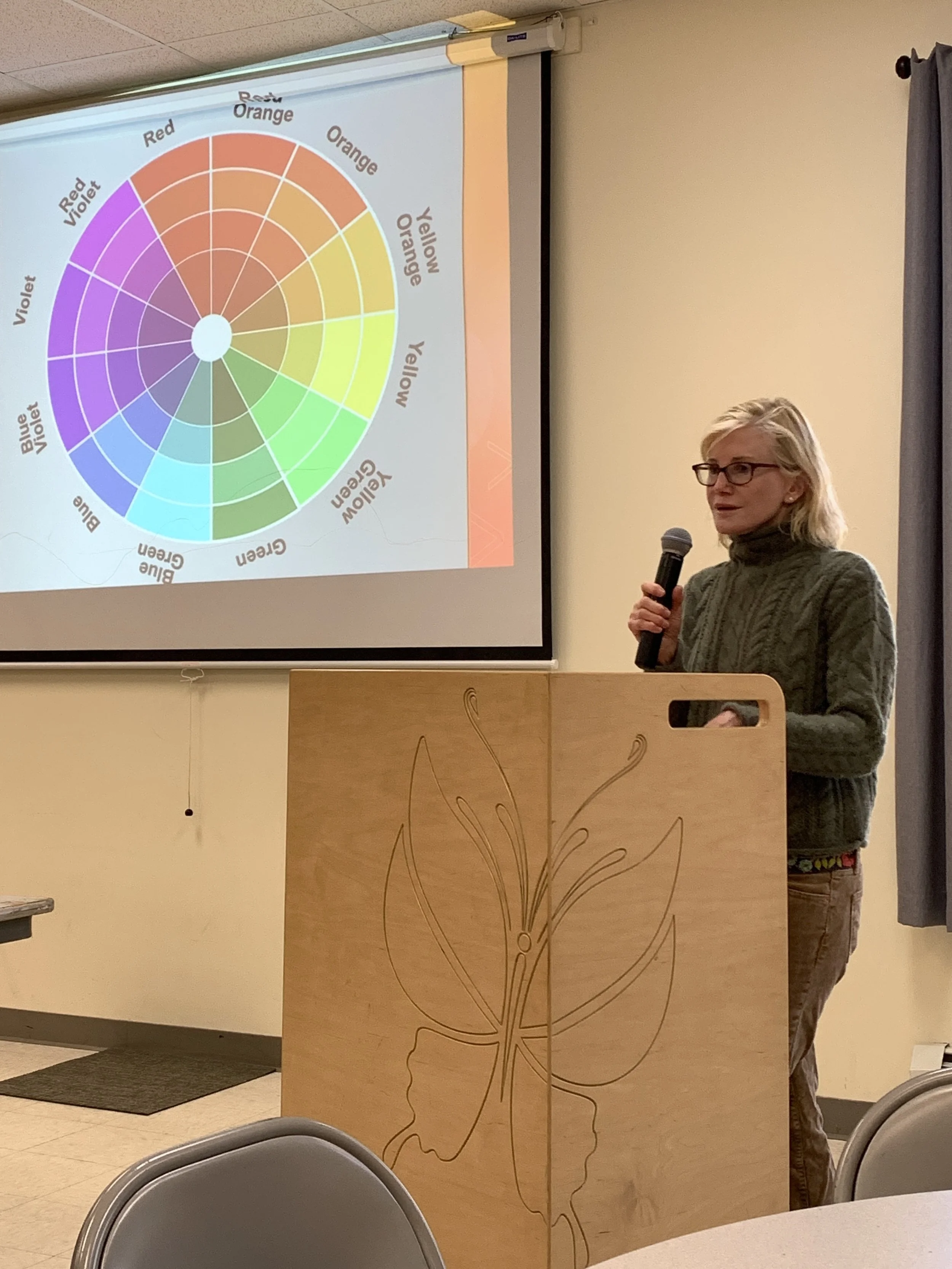
Susie shared her many slides and brought color theory wheels for us to reference. Her slides took us through each of the four seasons in Vermont and explained the basics of using color theory in gardens. Complementary color combinations (those that sit opposite of each other on the color wheel, provide a harmonic experience when paired—ex: orange pumpkins paired with purple asters). A method to create a mood in a garden would be to use analogous color schemes which consist of three colors that sit side-by-side to one another on the color wheel—ex: blues, violets, and greens create a peaceful calm mood. She discussed how whites give our eyes a resting spot and silvers such as artemisia and dusty miller enhance the colors next to them.
Susie’s horticulture knowledge, when added to her art knowledge, provided us with helpful growing tips and left us with new ideas to ponder for next year’s gardens.